"Endgame" is the title of the series finale of the Star Trek spinoff series, Star Trek: Voyager. Originally shown as a double-length episode and presented as such in DVD collections, it is shown in repeat broadcasts as two linked episodes.
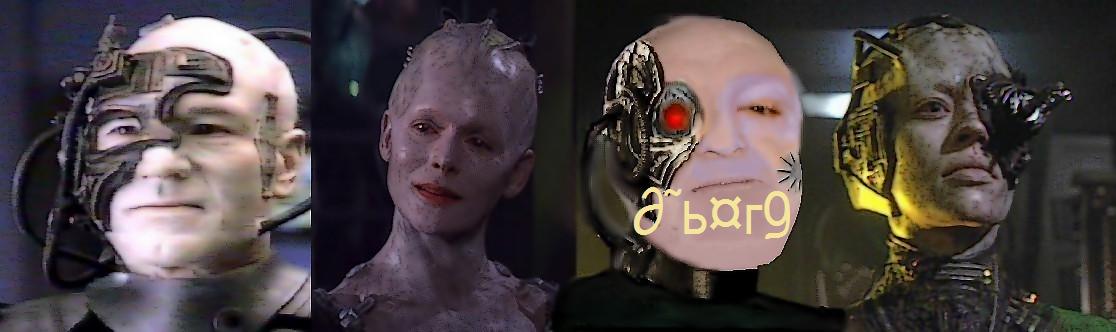
WE ARE THE BORG....
| “ | ....Resistance is futile... | ” |
| “ | Space: the final frontier. These are the voyages of the starship Enterprise. Its five-year mission: to explore strange new worlds, to seek out new life and new civilizations; to boldly go where no man has gone before. | ” |
Tuesday, 8 December 2009
Key moments in Star Trek Voyager (3)
"Endgame" is the title of the series finale of the Star Trek spinoff series, Star Trek: Voyager. Originally shown as a double-length episode and presented as such in DVD collections, it is shown in repeat broadcasts as two linked episodes.
Monday, 7 December 2009
Key moments in Star Trek Voyager (2)
"Pathfinder" is the 10th episode of the 6th season of Star Trek: Voyager. It has an average fan rating of 4.1/5 on the official Star Trek website as of September, 2009 and features the characters Reginald Barclay and Deanna Troi from Star Trek: The Next Generation.
On Earth, Reginald Barclay is involved in the Pathfinder project, an effort to communicate with the USS Voyager stranded in the Delta Quadrant. Barclay soon becomes obsessed. He loses himself in the reality of the holographic Voyager created for the project, enjoying the false friendships within.
He seeks help from old friend and shipmate Counselor Deanna Troi who advises him to forge real relationships and stop straying into the holo-program he has created of the Voyager ship and crew. When Admiral Paris visits the project to inspect progress, Barclay ignores orders from Commander Harkins, the project leader, not to bother the Admiral with his unfeasible suggestions. Barclay puts forward his theory that using an advanced sensor array, and computing Voyagers progress from their last contact, they would be able to create a micro wormhole in the Delta Quadrant near Voyager and use it to create a two way communication link. Admiral Paris is intrigued by this and promises to give it further study which Barclay is highly excited by, but at a later meeting with Admiral Paris, Barclay oversteps the line and is removed from the project for insubordination.
Later that night, he breaks back in to the pathfinder project to prove his theory is correct. He hacks into the system and sends commands to the array which, as he predicted, creates the wormhole in the Delta Quadrant. As he attempts to contact Voyager using the array, Starfleet detects and sends security personnel to stop him. Barclay locks out the system and takes refuge in the holodeck simulation of Voyager where he continues to direct the wormhole to locate Voyager. The security officers led by Commander Harkins follow Barclay into the simulation where the faux Voyager crew rebels, even firing on the security officers. Of course, this does nothing as the security protocols are on. The holo-Torres is destroyed by a pursuing Commander Harkins, who shuts down the primary cooling systems on the holographic Voyager which will cause the warp core to overheat and breach, effectively destroying the entire program unless Barclay complies and releases command back to him.
As a dejected Barclay is led out, Admiral Paris enters the lab and announces them that Barclay's idea has real promise and should be explored further. As he is informed that the attempt has already been made and was unsuccessful, Admiral Paris expresses regret at Barclays choice to disregard protocol.
Meanwhile, the real Voyager far in the Delta Quadrant detects the micro-wormhole and a communication signal which Seven of Nine disbelievingly identifies as Federation in origin on a Starfleet Emergency Channel . The crew attempts to clear up the signal while back on Earth, the jubilant officers and Barclay assist. For a few seconds the team on Earth clear up the return signal, two-way communication is established for 86 seconds before the micro-wormhole collapses. A few words are exchanged and data from Voyager's logs, crew reports, and navigational records are transmitted to Earth. Barclay sends "data on some new hyper-subspace technology" in hopes Voyager's crew will eventually use it to stay in regular contact as well as recommended modifications to the com system. In the final seconds, the crew hear some moving words from Admiral Paris ending with, "I want you all to know we're doing everything we can to bring you home."
To celebrate the knowledge that home is looking for them and regular communication will be possible in due time, the crew of Voyager hold a party in honor of Barclay. They discuss what little they know of him through his personnel record and declare he is an honorary Voyager crewmember.
Saturday, 5 December 2009
Key moments in Star Trek Voyager (1)
Tear jerking stuff from UPN...
"Message in a Bottle" is a popular episode of Star Trek: Voyager, the fourteenth episode of the fourth season. The episode has an average rating of 4.6/5 on the official Star Trek website (as of May 11, 2007)
After successfully extending the range of Voyager`s sensors, Seven of Nine locates a network of alien sensor stations. Patching into this, she is able to locate a Federation vessel on the far reaches of the Alpha Quadrant, the USS Prometheus. Voyager's crew attempts to send a message along the relay, but it is reflected back to them after degrading en route. Theorizing that a holographic signal would be stronger, and not degrade so quickly, they send The Doctor as a datastream.
Upon arrival, The Doctor discovers that the Prometheus is an experimental warship developed in secret by the Federation, however the Romulans have learned of its existence and captured the vessel. Being pursued by the USS Bonchune, the Romulans initiate the first test of the new multi-vector assault mode, in which Prometheus splits into three separate pieces to engage hostile ships.
Seeking assistance, The Doctor activates the ship's own EMH, a Mark II of the program. The second EMH cites protocol for an EMH to deactivate when its vessel was taken over, but Voyager's doctor notes that as both ships were at stake, they do not have that luxury.
Using the pretense of an infection on board, the Doctor goes to the bridge in an effort to open the atmospheric filters to flood the ship with anesthetizing gas and knock the Romulans unconscious. The ruse fails, but when he is captured and interrogated, The Doctor keeps the Romulans stalled long enough for the EMH Mark II to fool the ship's computer into opening the filters, permitting the distribution of the gas.
Unfortunately, by the time they take control, Prometheus has reached the designated rendezvous point, and three D'deridex-class warbirds are ready to take delivery. Unfamiliar with the helm and weapons systems, the two EMH programs unsuccessfully attempt to fool the Romulans into leaving, before three more Starfleet vessels arrive to retake their ship. In the ensuing battle, all six other vessels target Prometheus. EMH Mark II stumbles upon the command to put the ship into multi-vector assault mode. The strength of the Prometheus is quickly demonstrated when it easily overpowers and destroys one of the Romulan warbirds. With that loss, the Romulans retreat, and a Starfleet security detail transports over to the Prometheus.
Meanwhile, the Hirogen, owners of the sensor array, have contacted Voyager, and demand they log off the relay. Seven of Nine zaps the threatening Hirogen officer with a feedback loop, and the Voyager crew await a response from the Alpha Quadrant. After the battle with the Romulans, the Doctor gets through and materializes in sickbay. He has good news: he has updated Starfleet on Voyager's situation. This is the first time Starfleet has heard from the vessel since it disappeared four years ago. Voyager was removed from the Starfleet list of destroyed ships (having been listed for fourteen months), and a message sent back: "You're no longer alone". Starfleet will be trying their best to return Voyager home, as well as tell their families that the crew is alive.
- The Dominion War is briefly mentioned when the EMH Mark II mentions to the Doctor that "the Romulans haven't gotten involved in their fight with the Dominion." Three months later, in "[[In the Pale Moonlight]], the Romulans would become involved and oppose the Dominion.
- The Crew of Voyager makes contact with home for the first time since they were lost in the Delta Quadrant in the first episode of the series.
- This episode also marks the halfway point in the series.
Thursday, 19 November 2009
We Are The Borg "Resistance is futile"
The Borg manifest as (more...)
Wednesday, 18 November 2009
Star Trek: The Original Series
| “ | Space: the final frontier. These are the voyages of the starship Enterprise. Its five-year mission: to explore strange new worlds, to seek out new life and new civilizations; to boldly go where no man has gone before. | ” |
Tuesday, 17 November 2009
Star Trek: The Animated Series
The series was produced by Filmation in association with Paramount Television and ran for two seasons from 1973 to 1974 on NBC, airing a total of twenty-two half-hour episodes. An early Filmation proposal for this series had children assigned to each of the senior officers as cadets, including a young Vulcan for Mr. Spock. According to interviews with Norm Prescott, Paramount offered Roddenberry a substantial sum of money to abandon creative control of the project and let Filmation proceed with their "kiddy space cadet" idea. Roddenberry refused. Filmation would later develop the idea into its own original live action program: Space Academy in 1977.
The writers of the animated series used, essentially, the same writers' guide that was used for the live-action Star Trek: The Original Series. (A copy of the "series bible", as revised for TAS, is held in the science fiction research collection at the Samuel Paley Library, Temple University, Philadelphia.)
While the freedom of animation afforded large alien landscapes and believable non-humanoid aliens, budget constraints were a major concern and the animation quality was generally only fair, with very liberal use of stock shots (as was often the case with many of Filmation's shows). There were also occasional mistakes, such as characters appearing on screen who were elsewhere, or a character supposed to appear on the bridge's main viewing screen, but then appeared in front, indicating bad ordering of animation plates. These were typically isolated errors however. Occasionally, though, parts of episodes would be animated at a near-theatrical quality level.
All the episodes of this series were novelized by Alan Dean Foster and released in ten volumes under the Star Trek Logs banner. Initially, Foster adapted three episodes per book, but later editions saw the half-hour scripts expanded into full novel-length stories.
Star Trek: The Animated Series was the only Star Trek series to not feature a cold open ("teaser") and started directly with the title sequence (although some overseas versions of the original live action series, such as that run by the BBC in the U.K. in the 1960s and 1970s, ran the teaser after the credits).
The writing in the series benefited from a Writers Guild of America, East strike in 1973, which did not apply to animation. A few episodes are especially notable due to contributions from well-known science fiction authors:
- "More Tribbles, More Troubles" was written by David Gerrold as a sequel to his famous episode "The Trouble with Tribbles" from the original series. Here Cyrano Jones is rescued from the Klingons, bringing with him a genetically-altered breed of tribbles which do not reproduce but do grow extremely large. (It is later discovered that these are really clusters of tribbles who function as a single tribble, and it is decided that the large numbers of smaller tribbles are preferable to the larger ones.) The Klingons, due to their hatred of tribbles, are eager to get Jones back because he stole a creature they created: a predator that feeds on tribbles. This episode was originally written with the intention of being an episode of the live-action original series, but this was vetoed by Fred Freiberger who wanted serious sci-fi episodes instead.[citation needed]
- "Yesteryear" is a time-travel episode in which Mr. Spock uses "The Guardian of Forever", a time gateway from the original series episode "The City on the Edge of Forever", to travel to his own childhood past. This is the only animated Trek episode written by original series and later Next Generation writer D.C. Fontana. This was the first actual appearance of Spock's pet sehlat, first mentioned in "Journey to Babel" and finally named I-Chaya in this episode.
- Larry Niven's "The Slaver Weapon", adapted from his own short story "The Soft Weapon". It includes some elements from his Known Space mythos such as the Kzinti and the Slavers. This is the only Kirk-era TV or movie story in which Kirk didn't appear. This episode also has the distinction of being the only animated episode where anyone dies or is killed onscreen.
- "The Magicks of Megas-tu", by Larry Brody, sends the Enterprise to the center of the galaxy. Its crew find themselves befriended by a devil-like alien named Lucien, whom they must defend against accusations that he has brought evil to the world of Megas-tu.
Filmation later went on to produce the hit He-Man and the Masters of the Universe (1983-85), which occasionally used modified character and set designs from Star Trek: The Animated Series, mostly as background material. (He-Man and the Masters of the Universe also had several Trek-similar stories, most notably "The Arena", which is very similar to Star Trek: The Original Series's first season episode, "Arena"). Later series also shared many of the stock sound effects from both Star Trek: The Animated Series and Star Trek: The Original Series. Filmation also recycled some of the background music for Star Trek: The Animated Series in their later shows Shazam!, Tarzan and the Super 7 and Sport Billy. (Some of the music had already been reused from the previous season's Brady Kids and the Treasure Island feature, and were shared with that season's Lassie's Rescue Rangers).
In addition, a few facts introduced in the animated series have been referred to in the live-action productions:
- Kirk's middle name, Tiberius, was first introduced in "Bem", then subsequently referred to in several Star Trek novels (most notably the novelization of Star Trek: The Motion Picture by Roddenberry). The name was conclusively established as part of the Trek canon in Star Trek VI: The Undiscovered Country.
- Amanda's maiden name, Grayson.
- A second exit for the bridge, referred to in Franz Joseph's Star Fleet Technical Manual and seen in the refitted Enterprise and the NCC-1701-A from the first six Star Trek movies.
- The kahs-wan ritual Spock endures in "Yesteryear".
- Klingon commander Kor's command of the battlecruiser Klothos.
- Doctor Phlox uses Edosian slugs in his medical bay, and Chef once served up Edosian sucker fish, similar to Earth's catfish, as a meal, in the series Star Trek: Enterprise. They come from the same planet as Lieutenant Arex, as do Edosian orchids mentioned by Elim Garak in Star Trek: Deep Space Nine.
- The Vulcan city, ShiKahr, has been referred to in multiple series (sometimes misspelt "ShirKahr"), and can be seen in an episode of Enterprise. A Vulcan city which looks very similar to the ShiKahr of Star Trek: The Animated Series was shown in the new CGI establishing shots used in the special edition of "Amok Time".
- Some of the worlds and aliens in the series were included in the 1989 book called Star Trek: The Worlds of the Federation.
- Some of Sarek's dialog from "Yesteryear", and young Spock being bullied by Vulcan classmates, are given homage in the 2009 feature film, Star Trek.
Monday, 16 November 2009
Star Trek: Phase II...
Star Trek: The Next Generation
Roddenberry hired a number of Star Trek veterans, including Bob Justman, D. C. Fontana, Eddie Milkis, and David Gerrold. Paramount executive Rick Berman was assigned to the show at Roddenberry's request.
Sunday, 15 November 2009
Star Trek: Deep Space Nine
According to co-creator Berman, he and Piller had considered setting the new series on a colony planet, but they felt a space station would both appeal more to viewers and save money that would be required for on-location shooting for a "land-based" show. However, they were certain they did not want the show to be set aboard a starship because Star Trek: The Next Generation was still in production at the time and, in Berman’s words, it "just seemed ridiculous to have two shows—two casts of characters—that were off going where no man has gone before."[2]
In the pilot, the station is moved near the just-discovered Bajoran wormhole, allowing access to the distant, unexplored Gamma Quadrant. It quickly becomes a center for exploration, interstellar trade, political maneuvering, and eventually open conflict.
DS9 contains more story arcs that span several episodes and even seasons than preceding Star Trek series. Its predecessors tend to restore the status quo ante at the end of an episode, so that many episodes could be seen out-of-order without compromising their plots. On DS9 however, not only are events in one episode often referenced and built upon in later ones, but sometimes several episodes in a row are cliffhangers. Michael Piller, who spoke very highly of Behr's contributions, believed this to be one of the series' best qualities, that the repercussions of past episodes remained with the show and characters were forced to "learn that actions have consequences". This trend was especially strong near the end of the series’ run, by which point the show was intentionally very much a serial
Contrary to Star Trek: The Next Generation, interpersonal conflicts were featured prominently in DS9. This was at the suggestion of Star Trek: The Next Generation’s writers (many of whom also wrote for DS9) because they felt that the prohibition limited their ability to develop interesting stories. In Piller's words, "people who come from different places — honorable, noble people — will naturally have conflicts"
Saturday, 14 November 2009
Star Trek: Voyager
Voyager was produced to launch UPN, a television network planned by Paramount. (Paramount considered launching a network on its own in 1977, which would have been anchored by the TV series Star Trek: Phase II.) Planning started in 1993, and seeds for the show's backstory, including the development of the Maquis, were placed in several Star Trek: The Next Generation and Star Trek: Deep Space Nine episodes. Voyager was shot on the same stages The Next Generation had used. The pilot, "Caretaker," was shot in October 1994. Around that time, Paramount was sold to Viacom - in fact, Voyager was the first Star Trek TV series to premiere after the sale had concluded.
Voyager was the first aired UPN program at 8:00 p.m. on January 16, 1995. Voyager was also the first Star Trek TV show to use Computer Generated Imagery (CGI) exclusively, and eliminate the use of models for exterior space shots. Other television shows such as seaQuest and Babylon 5 had exclusively used CGI to avoid the huge expense of models, but the Star Trek television department continued using models, because they felt models provided better realism. Amblin Imaging won an Emmy for the opening title visuals, but the weekly episode exteriors were still captured using hand-built miniatures of the Voyager, shuttlecraft, and other ships, the same method used for The Next Generation and Deep Space Nine.
That changed when Star Trek: Voyager became Paramount's first television property to go fully CGI in mid-season 3 (late 1996). Paramount obtained an exclusive contract with Foundation Imaging which had done the effects for Babylon 5's first three seasons. Season 3's "The Swarm" was the first episode to use Foundation's effects exclusively. Deep Space Nine started using Foundation Imaging in conjunction with Digital Muse one year later (season 6), after Voyager had successfully proven that CGI could look as realistic as models. In its later seasons, "Voyager" featured visual effects from Foundation and Digital Muse (later to become Eden FX).
In the pilot episode, "Caretaker," Voyager is on a mission to locate a missing ship piloted by Maquis fighters. Janeway brings Tom Paris, a former Starfleet officer and Maquis, out of prison to help find the ship. Maneuvering through the dangerous Badlands, an ancient alien known as the Caretaker transports Voyager to the Delta Quadrant, 70,000 light years on the other side of the galaxy, where the Maquis ship was also sent. In the process, several members of Voyager's crew are killed, including the first officer, helmsman, chief engineer, and all medical personnel.
Voyager and the Maquis ship are attacked by Kazon raiders intent on capturing the Caretaker's Array, which was used to transport the ships. The Maquis ship collides with a Kazon ship, destroying both, after the Maquis crew transports to Voyager. Believing the Kazon will use the Array to harm the Ocampa, Janeway decides to destroy it rather than use it to return home.
The Starfleet and Maquis crews integrate and work together as they begin the 70,000-light-year journey home, predicted to take 75 years. Chakotay, leader of the Maquis group, becomes first officer. B'Elanna Torres, a half-human/half-Klingon Maquis becomes chief engineer. Tuvok is revealed to be a Starfleet spy on the Maquis ship and resumes his duties as chief security officer. The ship's operations officer is Harry Kim. Paris becomes the helmsman, and the Emergency Medical Hologram, designed for only short-term use, becomes the chief medical officer. At first the EMH is confined to sickbay and holodecks, but during the course of the series gains his freedom by way of a mobile holo-emitter, as well as expanding his program and personality on his own initiative. While in the Delta Quadrant, the crew gains the Talaxian Neelix as a local guide and chef, along with his Ocampan girlfriend, Kes. Both Paris and Kes become qualified assistants to the Doctor, expanding the ship's medical capability. In the show's fourth season, the crew grows to include Seven of Nine, a Borg drone liberated from the collective who, like the Doctor, expands (or rather, regains) her humanity throughout the series.
The Delta Quadrant is mostly unexplored by the Federation, of which Starfleet is the military/exploration/peacekeeping arm. On the way home, the crew contends with hostile forces that include organ-harvesting Vidiians, belligerent Kazon, nomadic Hirogen hunters, Species 8472 from fluidic space and most notably the Borg in the later seasons when Voyager has to move through large areas of Borg space. They also encounter hazardous natural phenomena such as a Nebulous area called the Nekkrit Expanse, a large area of empty space called the Void, wormholes and other anomalies. Voyager is the third Star Trek series to feature Q. Meanwhile, Starfleet Command learns of Voyager's survival and situation and eventually develops a means to establish regular audiovisual and data contact with the ship thanks to the efforts of Reginald Barclay who was featured more prominently on The Next Generation.
Thursday, 12 November 2009
Star Trek: Enterprise
In May 2000, Rick Berman, executive producer of Star Trek: Voyager, revealed that a new series would premiere following the final season of Voyager. Little news was forthcoming for months as Berman and Brannon Braga developed the untitled series, known only as Series V, until February 2001, when Paramount signed Herman Zimmerman and John Eaves to production design Series V. Within a month, scenic designer Michael Okuda, another long-time Trek veteran, was also signed Michael Westmore, make-up designer for Trek since Star Trek: The Next Generation (TNG), was announced as working on Series V by the end of April. Returning as director of photography would be Marvin V. Rush, who had been working on various Treks since the third season of TNG. For visual effects, Ronald B. Moore, who had previously worked on TNG and Voyager, was brought in.
However, the biggest news would wait until May 11, 2001. The title of Series V was revealed to be Enterprise, with Scott Bakula, of Quantum Leap fame, playing Captain Jeffery Archer, a name that was quickly changed to Jonathan Archer due to fan feedback. Four days later, the rest of the main cast was announced, though the character names would not be announced until the next day.
Wednesday, 11 November 2009
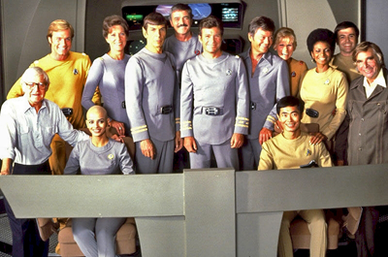
Star Trek: The Motion Picture
A Starfleet monitoring station detects an alien force hidden in a massive cloud of energy moving through space towards Earth. The cloud destroys three Klingon warships and the monitoring station en route. On Earth, the starship Enterprise is undergoing a major refit; its former commander, James T. Kirk, has been promoted to Admiral and works in San Francisco as Chief of Starfleet Operations. Starfleet dispatches the Enterprise to investigate the cloud entity as the ship is the only one in intercept range, requiring its new systems to be tested in transit.
Kirk takes command of the ship citing his experience, angering Captain Willard Decker, who had been overseeing the refit as its new commanding officer. Testing of Enterprise's new systems goes poorly; two officers, including the science officer, are killed by a malfunctioning transporter, and improperly calibrated engines almost destroy the ship. The tension between Kirk and Decker increases when the admiral demonstrates his unfamiliarity with Enterprise. Spock arrives as replacement science officer, explaining that while on his home world undergoing a ritual to purge all emotion, he felt a consciousness that he believes emanates from the cloud.
The Enterprise intercepts the energy cloud and is heavily damaged by an alien vessel. A probe appears on the bridge, attacks Spock and abducts the navigator, Ilia. She is replaced by a robotic doppelgänger, a probe sent by "V'ger" to study the crew. Decker is distraught over the loss of Ilia, with whom he had a romantic history. He becomes troubled as he attempts to extract information from the doppelgänger, which has Ilia's memories and feelings buried within. Spock takes a spacewalk to the alien vessel's surface and attempts a telepathic mind meld with it. In doing so, he learns that the vessel is V'ger itself, a living machine.
At the heart of the massive ship, V'ger is revealed to be Voyager 6, a 20th-century Earth space probe believed lost. The damaged probe was found by an alien race of living machines that interpreted its programming as instructions to learn all that can be learned, and return that information to its creator. The machines upgraded the probe to fulfill its mission, and on its journey the probe gathered so much knowledge that it achieved consciousness. Spock realizes that V'ger lacks the ability to give itself a focus other than its original mission; having learned what it could on its journey home, it finds its existence empty and without purpose. Before transmitting all its information, V'ger insists that the Creator come in person to finish the sequence. Realizing that the machine wants to merge with its creator, Decker offers himself to V'ger; he merges with the Ilia probe and V'ger, creating a new form of life that disappears into another dimension. With Earth saved, Kirk directs the Enterprise out to space for future missions.